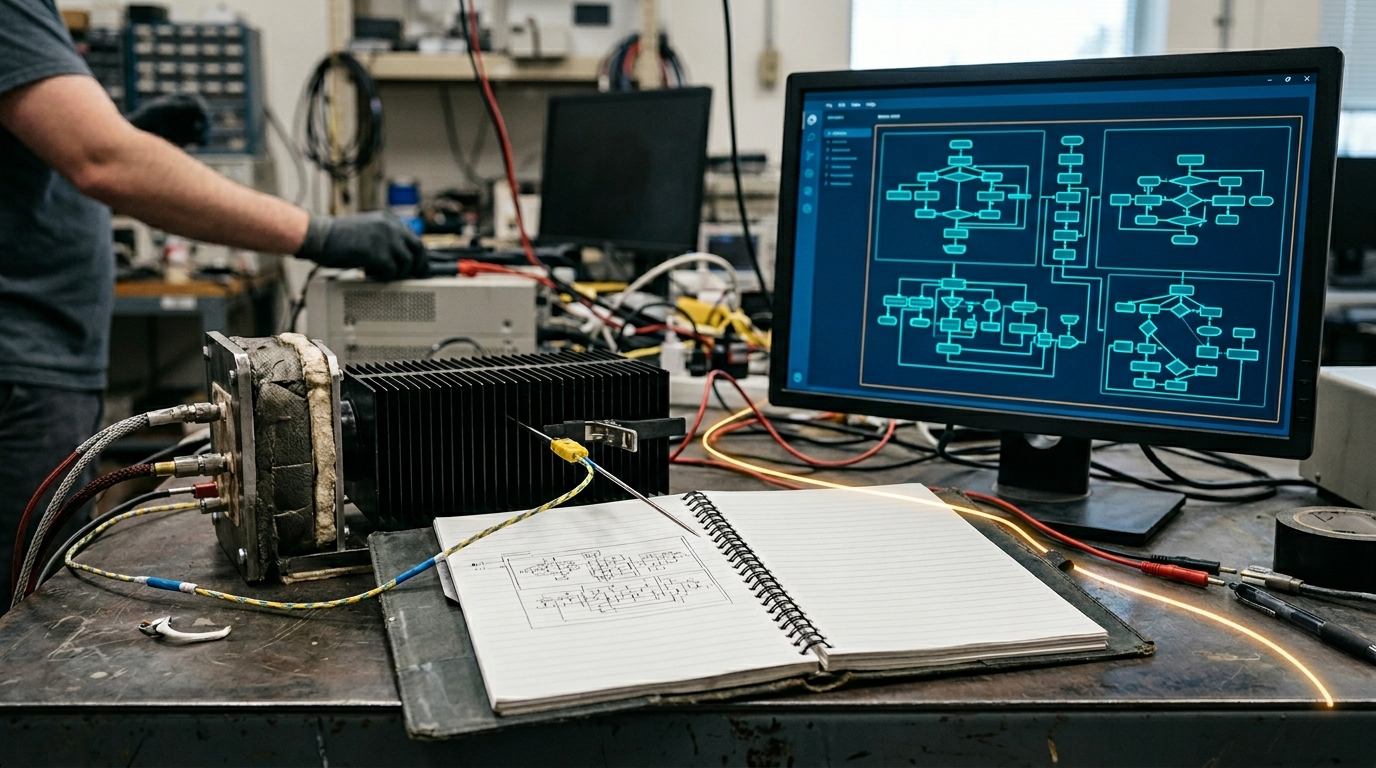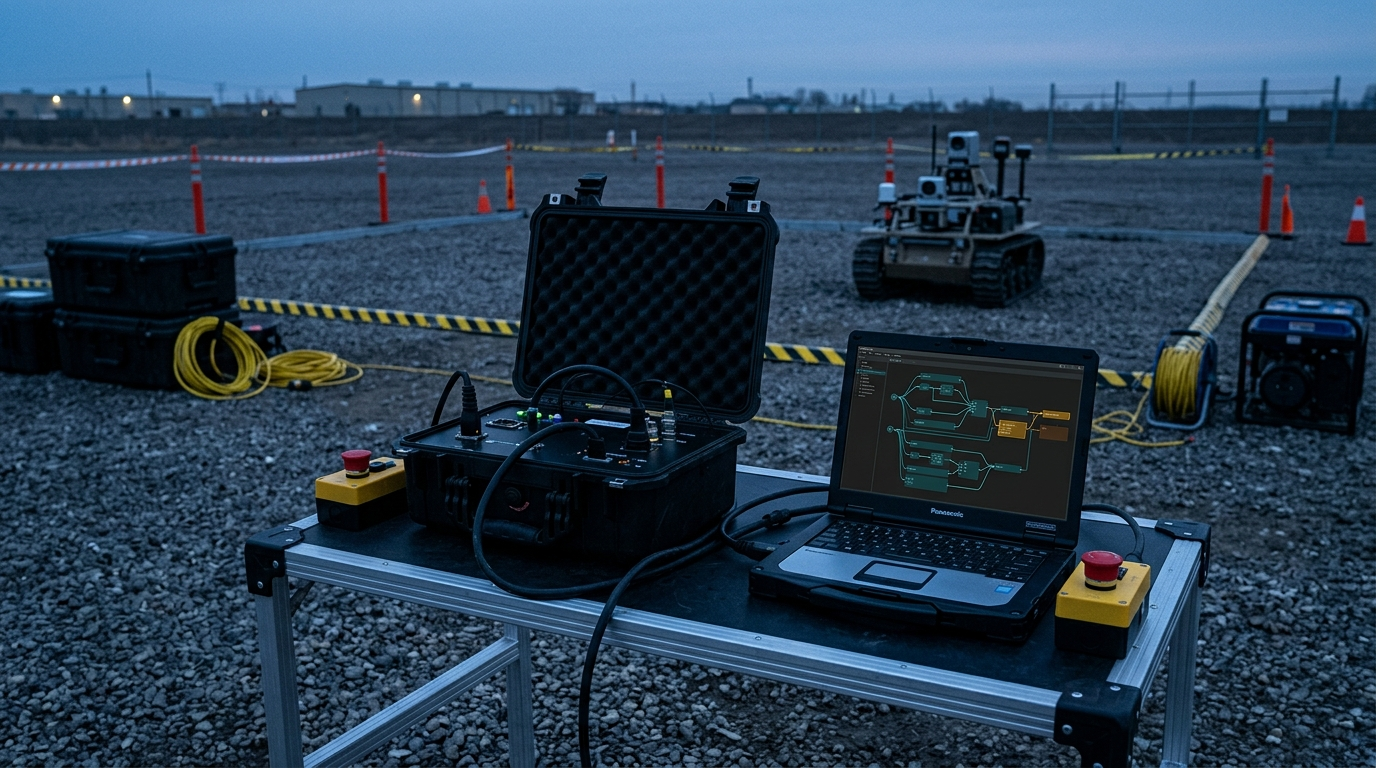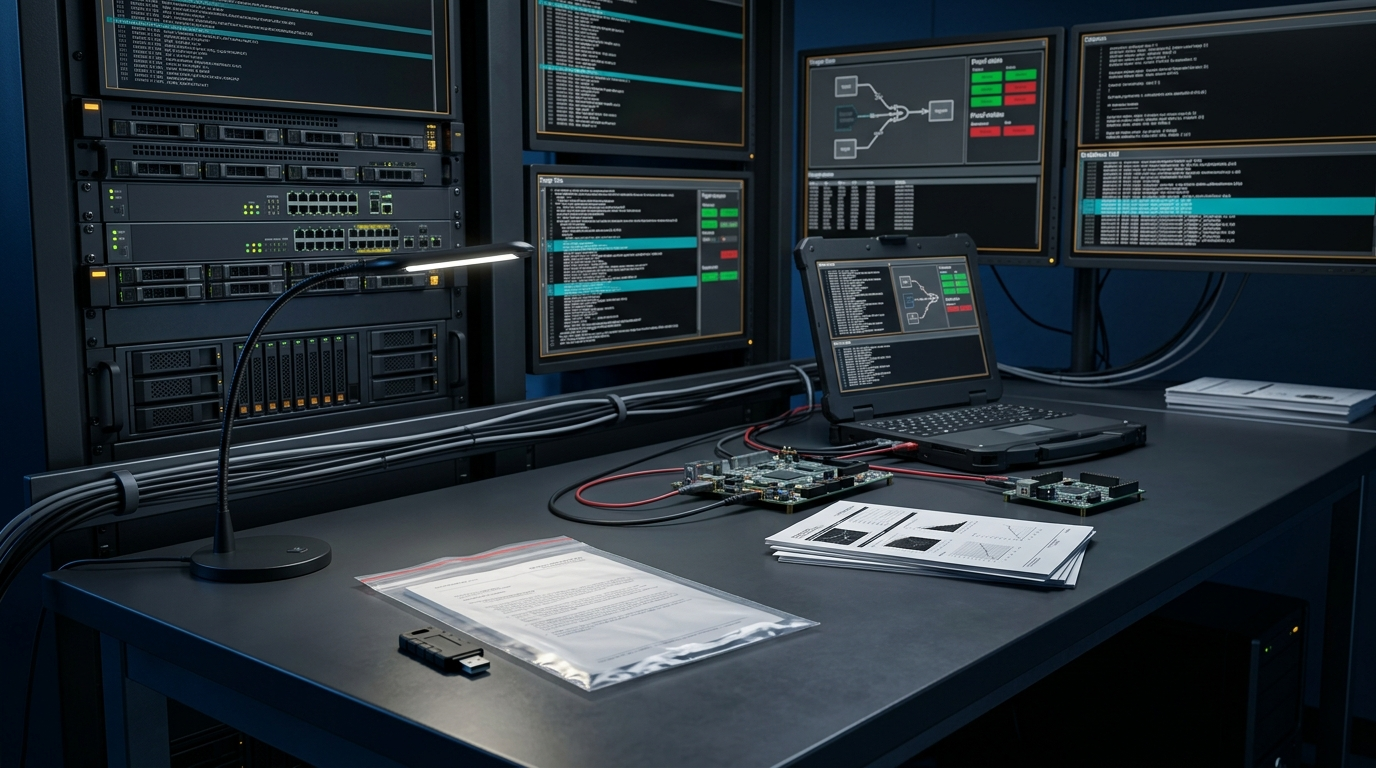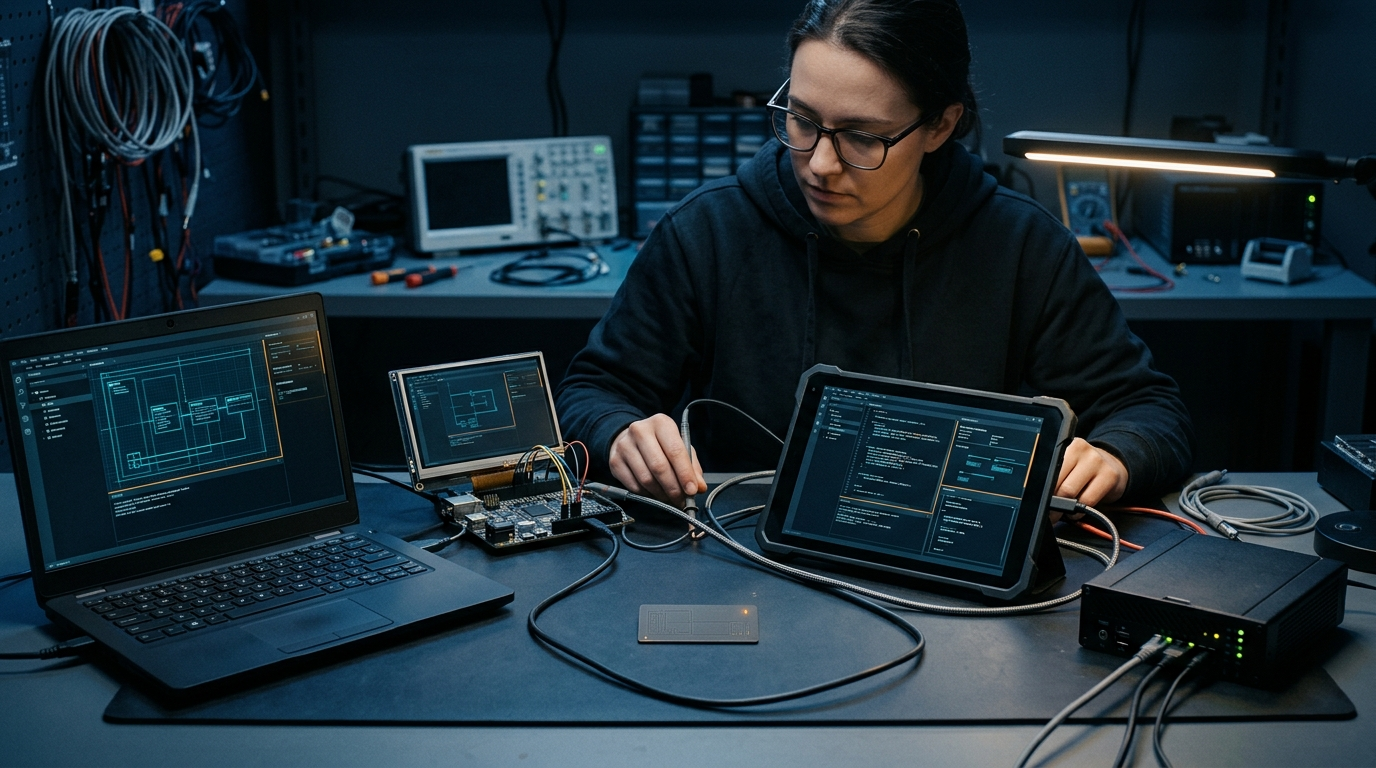
128 Operations. Every Program a Circuit.
Here is the problem. Every piece of software you use — your banking app, your medical records system, the autopilot in your plane — is held together by hope. Developers write code, run tests that cover maybe 70% of paths, do code reviews that catch maybe 50% of bugs, and ship it. When it crashes at 3 AM, they debug it. When a security hole appears, they patch it. When an AI hallucinates, they add another guardrail. It is an endless, losing game.
Digital Circuitality ends that game. It makes software work like hardware — where some unsupported or structurally invalid candidates can be rejected before runtime.
Not better testing. Not more reviews. A fundamentally different architecture.
And today, we are going to show you exactly how it works.
The Insight: Biology Already Solved This
Nature builds every living organism from exactly 64 codons — 4 nucleotides cubed. Each codon maps deterministically to an amino acid. TGG always codes for tryptophan. ACG always codes for threonine. under declared constraints. No ambiguity. fewer unchecked structural defects. This system has been running in production for 4 billion years without a patch. The key properties are:
1. Each codon is verified. Its behavior is defined by biochemistry. It always produces the same amino acid. It cannot be ambiguous.
2. Composition follows laws. The genetic code is universal — all life on Earth uses the same 64 codons. Translation is deterministic, governed by biochemistry.
3. The code is closed. Input DNA goes into the ribosome, output protein comes out. If the code does not close, the protein does not fold — and the cell knows immediately.
Software has none of these properties. Functions can have bugs. Composition is ad-hoc — there are no algebraic laws for how modules combine. And there is no concept of closure — a program can produce garbage and you will not know until it is too late. BRIK64 changes all three.
128 Operations: The Complete Basis of Computation
BRIK64 is built on exactly 128 atomic operations called monomers — 64 core plus 64 extended, organized into 8 families. The parallel with biology is structural: a finite set of verified primitives that compose into arbitrary complexity. DNA codons encode 20 amino acids with redundancy; BRIK64 monomers are 128 distinct operations. The shared insight is architectural: finite, composable, deterministic building blocks scale without introducing uncertainty.
These 128 monomers cover arithmetic, logic, memory, control flow, I/O, strings, cryptography, and system operations — forming a complete basis for deterministic digital computation. Other languages give you infinite ways to write broken code. BRIK64 gives you 128 ways to write correct code.
Every single one is review-scoped. Not tested — proven. There are 207 proof files establishing that each monomer does exactly what its specification says, within the declared input domain, with under declared constraints. 110,000+ tests confirm it. Other systems test examples. BRIK64 proves structure.
EVA Algebra: The Kirchhoff's Laws of Software
Monomers combine into polymers (programs) through exactly three operators:
Sequential: output of A feeds input of B — like resistors in series
Parallel: A and B execute independently — like resistors in parallel
Conditional: if predicate, then A, else B — like a multiplexer
These operators satisfy algebraic laws — associativity, identity, verification closure — just like Kirchhoff's laws in electronics. If two monomers are correct, their composition is correct. Period. Correctness is preserved by construction, not by testing. Other systems pray that integration works. BRIK64 records bounded evidence for it mathematically.
TCE: The Multimeter for Software
The Thermodynamic Coherence Engine (TCE) measures seven properties of any program and produces a single number: closure (circuit closure). If closure check passed, the circuit is closed — every input is consumed, every output is produced, and the computation is coherent. If closure does not equal 1, something is wrong, and you know exactly which metric failed.
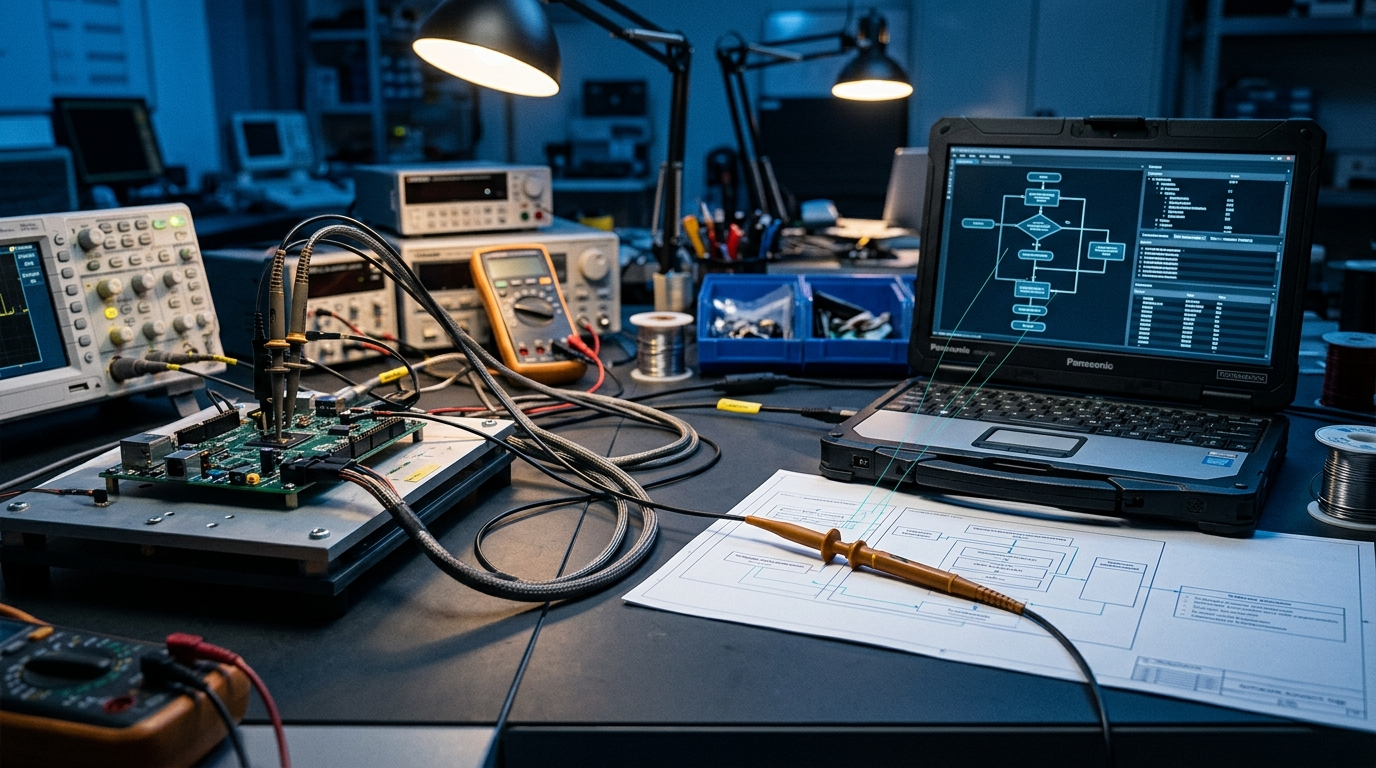
Think of it as putting a multimeter on a circuit. You do not need to run the circuit to know if it will work. You measure it first. Every other language makes you run the code to find the bugs. BRIK64 finds them before a single line executes.
The Compiler Compiles Itself
Here is the part that makes engineers stop and think. The PCD compiler — the tool that transforms .pcd programs into executables — is itself written in PCD. When the compiler compiles its own source code, it produces a binary with a specific cryptographic hash. When that binary compiles the source code again, it produces a binary with the same hash. This is a fixpoint — a self-referential evidence for the compiler path under its stated gate.
A chip that fabricates an exact copy of itself. And that copy fabricates another exact copy. Identical, every time. The circuit is closed. There is nothing more to prove. Few public tools in this category does this.
Why This Matters Right Now
AI is writing millions of lines of code every day. GitHub Copilot, Claude, GPT — they generate code at unprecedented scale. And none of it comes with a proof. We trust that it works because the AI was trained on good code. But training is not verification. Pattern matching is not proof. This is a ticking time bomb.
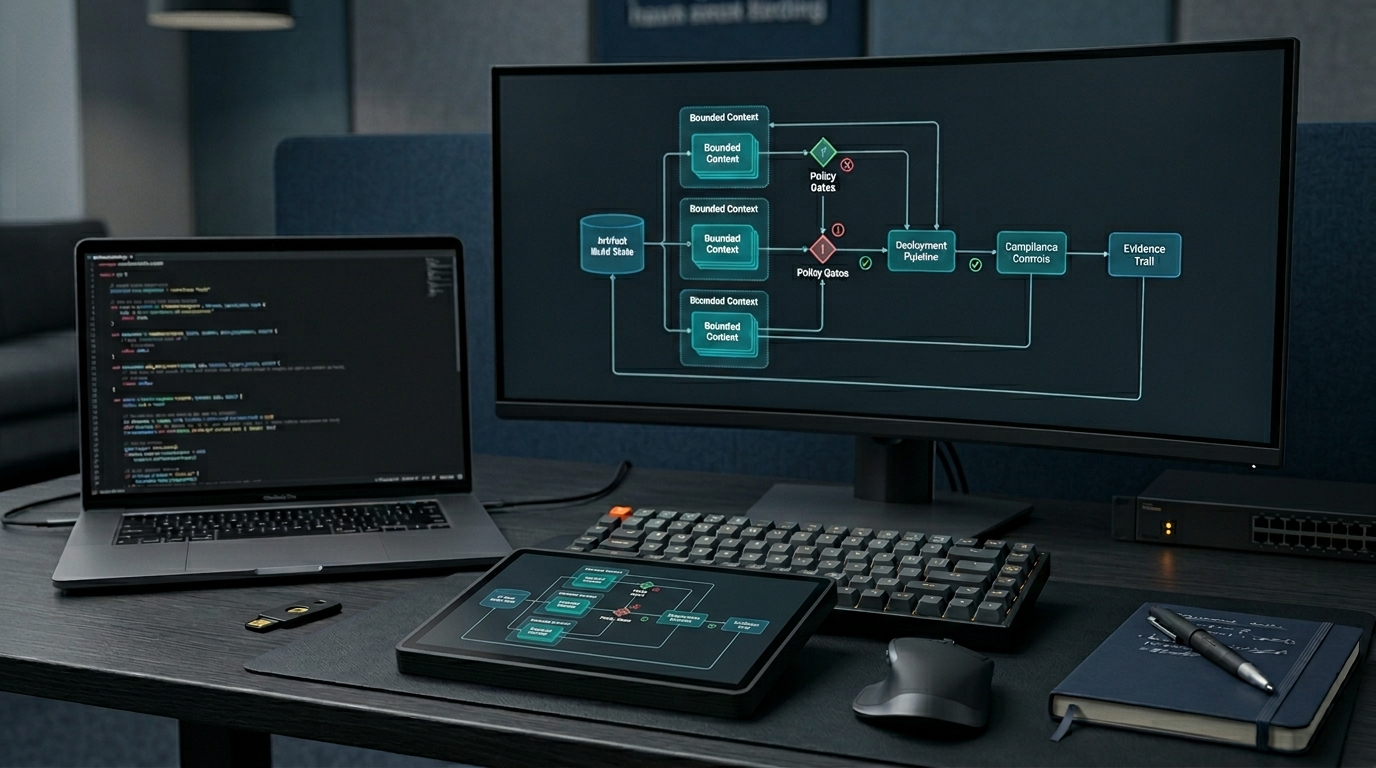
Digital Circuitality offers a different path: instead of teaching AI to write Python and hoping for the best, give it 128 verified operations and algebraic rules for combining them. Just as DNA constrains life to 64 codons to ensure hereditary fidelity, BRIK64 constrains computation to 128 monomers to ensure logical fidelity. If the result compiles and TCE says closure check passed, it is correct. Not probably correct. Not tested-and-seems-correct. supported by bounded evidence. Permanently.
What Comes Next
In the next post, we show you how Digital Circuitality works as a safety mechanism for AI agents — policy circuits that verify AI actions before they execute. Not prompts that say "please be good." bounded guarantees only where evidence supports them that enforce it.
In part three, we introduce the BPU — a dedicated hardware chip that implements Digital Circuitality in silicon. A physically separate safety layer that hardware enforcement requires separate evidence before it becomes a public product claim.
The circuit is closed. The proof boundary must remain explicit. The silicon awaits. Start building.
This is Part 1 of a three-part series. Part 2: AI Safety with Policy Circuits | Part 3: The BPU — Hardware That Says No