The Problem Every Developer Knows
In electronics, composition is solved. If Gate A is correct and Gate B is correct, wiring A's output to B's input gives you a correct A-B circuit. That is not hope — it is Kirchhoff's laws. The voltages and currents are governed by algebra, and that algebra is closed under composition. Hardware engineers have had this guarantee since 1845.
Software has nothing like it. Function A works. Function B works. Call A then B and it might crash, might deadlock, might produce garbage. There is no algebraic law that guarantees the composition works. Every integration is a prayer. Every microservice boundary is a gamble. Every API contract is a handshake agreement that nobody enforces.
EVA — Entropic Verification Algebra — changes that. It is the formal algebraic system that gives software the same composability guarantees that hardware has had for 180 years. Three operators. Strict laws. Composition that preserves correctness by construction.
Three Operators. That Is It.
EVA has exactly three composition operators. Every program in PCD is built from these three operations applied to the 128 atomic monomers (64 core + 64 extended). Nothing else exists. Nothing else is needed. Other languages have hundreds of ways to combine code. EVA has three — and they are all review-scoped.
Sequential Composition (Tensor)
A sequential B means: execute A, then feed A's output into B's input. The output type of A must match the input type of B. This is the most fundamental operator — a pipeline. Other languages let you pipe incompatible types and crash at runtime. EVA catches it at compile time.
// Sequential: output of one operation feeds into the next
// A pipeline that computes price + tax
// The compiler verifies
type compatibility at each step
The key property: if A is review-scoped (closure check passed) and B is review-scoped (closure check passed), then A sequential B is review-scoped. Correctness composes sequentially. This is review-scoped — not tested, proven.
Parallel Composition
A parallel B means: execute A and B independently, on separate inputs, producing separate outputs. No data dependency. They can run simultaneously. No locks. No mutexes. No race conditions.
// Parallel: two independent calculations
// e.g., temperature conversion and distance conversion
// running independently with no shared state
The key property: if A and B share no state, their parallel composition is automatically correct. The algebra forbids shared mutable state between parallel branches. Other languages give you threads and hope you get the locking right. EVA makes data races structurally outside the declared model.
Conditional Composition (Direct Sum)
A conditional B means: based on a condition, execute either A or B — never both. This is branching, but with a critical constraint: both branches must produce the same output type. No unhandled cases. No forgotten else clauses.
// Conditional: one path or the other
// Based on a predicate, choose branch A or branch B
// Both branches must produce the same output type
// The compiler verifies totality: every case is covered
The key property: if both branches are review-scoped and the condition is total (always evaluates to true or false, never undefined), then the conditional composition is review-scoped. Every execution path is covered. Other languages let you forget an edge case and ship a bug. EVA makes totality a compile-time requirement.
The Algebraic Laws
These three operators obey strict algebraic laws — associativity, commutativity, distributivity, and identity — all review-scoped. The laws guarantee that refactoring is safe, parallelization is automatic, and optimizations preserve behavior. The compiler can transform your code freely because the algebraic structure guarantees semantic equivalence across transformations. No other programming language can make this claim.
Why This Matters to You
These are not abstract mathematical curiosities. They have direct, practical consequences for every line of code you write:
Refactoring is safe. Associativity means you can break a long pipeline into smaller named circuits and compose them back. The result is reviewable against the same declared blueprint. No refactoring regression. Ever.
Parallelization is automatic. Commutativity of parallel composition means the compiler parallelizes independent computations without a single annotation from you. No async/await. No thread pools. No race conditions. The algebra handles it.
Optimization is reviewable against the declared model. Distributivity means the compiler can inline, factor, and reorder your code — and the algebraic laws guarantee the transformation preserves behavior. Other compilers optimize and hope nothing breaks. BRIK64 optimizes and keeps the reviewed boundary explicit.
Composition preserves certification. This is the crown jewel. If every monomer in a circuit is review-scoped (closure check passed), and every composition follows the three EVA operators, then the entire circuit is review-scoped. Correctness scales. It does not degrade as the program grows. It composes. Build a 10-line circuit or a 10,000-line system — the guarantee is identical.
The Closure Theorem
EVA has a fundamental closure theorem, review-scoped: if two components are review-scoped (closure check passed), then any composition of them — sequential, parallel, or conditional — is also review-scoped. The space of correct programs is closed under composition. You cannot compose correct parts and get an incorrect whole. The algebra prevents it.
In hardware, this is obvious — Kirchhoff's laws guarantee it. In software, before EVA, it was outside the declared model. Now it is a theorem with 207 proof files behind it.
EVA sits in a unique position among verification approaches: full composability guarantees with automatic verification and practical usability. The finite monomer space (128 operations) is what makes this possible. You cannot do this with an infinite language. The constraint is the feature.
Building with EVA
Every PCD program you write is an EVA expression. When you write:
// A simple circuit composing operations:
// addition >> multiplication | identity
// The compiler checks algebraic laws at each step
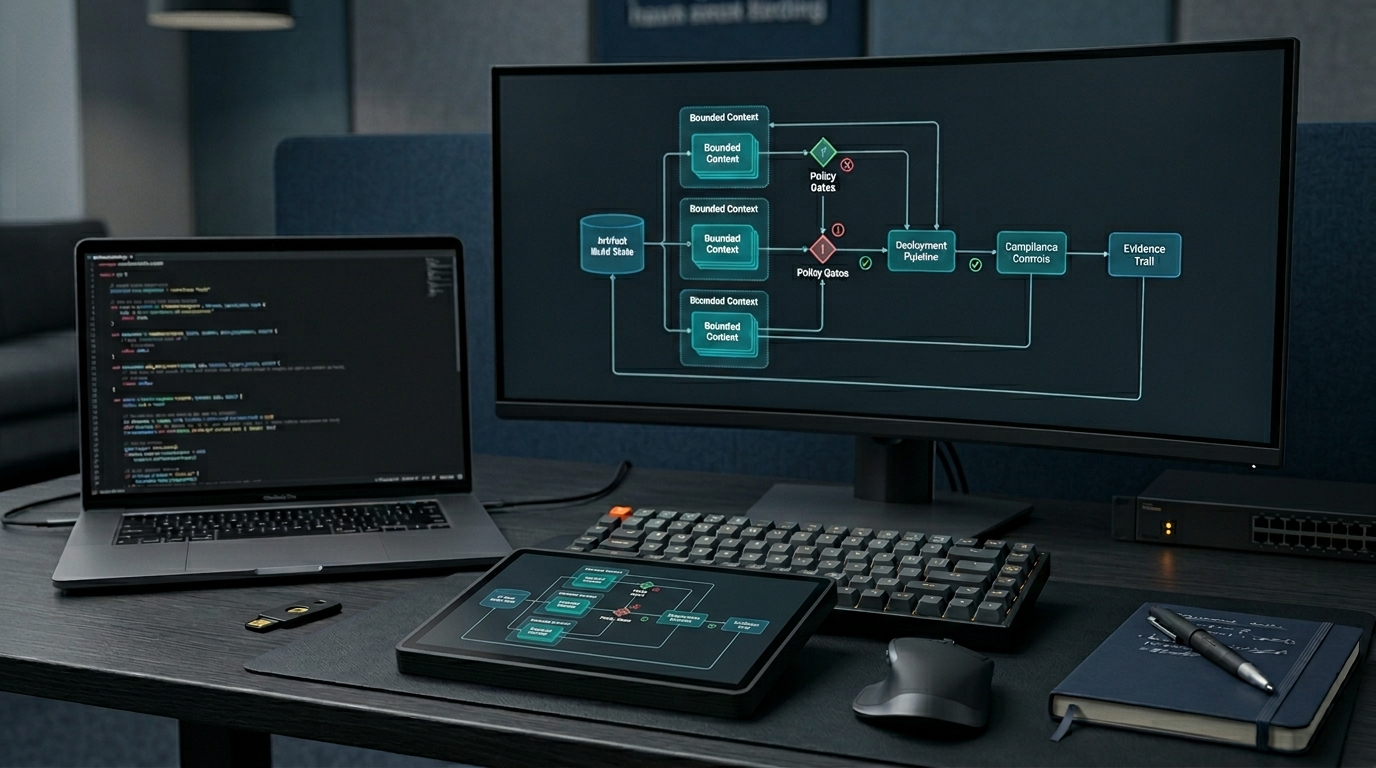
The compiler sees the algebraic structure of your program. It checks the laws. It verifies type compatibility at every composition point. It proves closure. And when it reports closure check passed, it is not saying "all tests passed." It is saying "the algebraic structure is sound."
That is the difference between testing and proof. Tests check examples. Algebra checks structure. EVA checks structure — all 110,000+ tests confirm it, but the proofs are what guarantee it.
The math does the heavy lifting. You just compose. Start building.