Every transpiler in existence converts one language to one other language. BRIK64 converts any of 10 to any of 14 — 140 review-scoped paths — with mathematical proof that the output is equivalent to the input.
Transpiler, Compiler, Interpreter — What's the Difference?
A compiler translates source code into machine code. GCC compiles C to x86. Rustc compiles Rust to native binaries. Low-level output: registers, memory addresses, jump instructions.
An interpreter reads source code and executes it line by line. Python's CPython reads your .py file and runs it immediately. No binary is produced. The source is the program.
A transpiler translates one high-level language into another. The output is still human-readable code. TypeScript transpiles to JavaScript. CoffeeScript transpiles to JavaScript. Babel transpiles modern JS to older JS.
Notice the pattern? Every transpiler you have ever used converts one language to one other language. TypeScript to JS. Sass to CSS. Kotlin to JVM bytecode. All 1-to-1. All without any guarantee that the output is equivalent to the input.
Why All Existing Transpilers Are 1-to-1
Building a transpiler is hard. You need to understand the source language's syntax, semantics, type system, edge cases, and runtime behavior. Then you need to map all of that onto the target language's constructs. A single mismatch — integer overflow, floating-point precision, string encoding — and the transpiled code behaves differently from the original.
This is why every transpiler is purpose-built for one pair of languages. The TypeScript compiler understands TypeScript and generates JavaScript. That is all it does. It does not generate Python. It does not accept Rust as input. The complexity of maintaining semantic fidelity across even one language pair is enormous.
Now multiply that by 10 input languages and 14 output targets. That is 140 possible transpilation paths. No team on Earth builds and maintains 140 transpilers.
Unless you change the architecture entirely. And that is exactly what BRIK64 does.
The N-to-N Architecture
BRIK64 does not build 140 transpilers. It builds 10 frontends (one per input language) and 14 backends (one per output target), connected through a single universal intermediate representation: PCD (Printed Circuit Description).
The architecture is elegant:
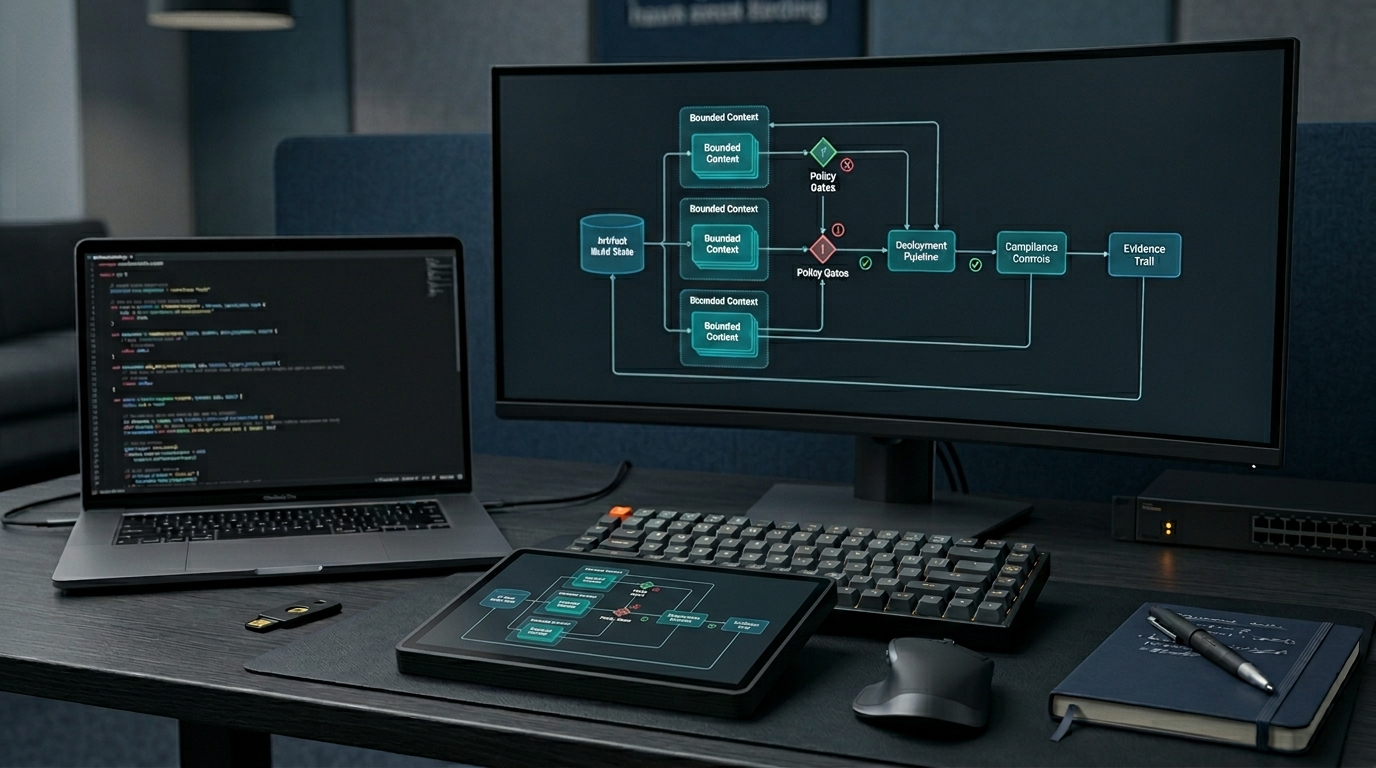
Source Language → Lifter → PCD Blueprint → TCE Check → Backend → Target LanguageEach frontend (the "Lifter") analyzes source code and maps it onto BRIK64's 128 review-scoped atomic operations — monomers. The result is a PCD blueprint: a circuit schematic that describes what the code does, not how it does it. Each backend reads that blueprint and emits idiomatic, clean code in the target language.This is the same insight behind LLVM. LLVM does not build a separate compiler for every language-to-architecture pair. It builds frontends (Clang for C, rustc for Rust) that emit LLVM IR, and backends that convert IR to x86, ARM, RISC-V. N frontends + M backends = N times M paths with N+M effort.
BRIK64 applies the same principle to source-to-source transpilation. But with one critical addition that LLVM does not have: mathematical certification. Every path through BRIK64 is proven correct. LLVM cannot say that.
One Command. supported targets.
Transpiling code with BRIK64 is a single command:
BRIK64 CLI transpile ./src/ --to rust --output ./dist/That is it. Point it at a directory of JavaScript, Python, Go, C, COBOL — whatever you have. Tell it the target. Get review-scoped, idiomatic output.
Behind the scenes, the command executes the full pipeline: lift, analyze, generate PCD, certify with TCE (closure check passed), emit target code, write output files. Every step is verified. Every output is review-scoped.
Real Example: COBOL Banking to Go
Here is a real scenario. A COBOL program that calculates compound interest — the kind of code running in thousands of banks worldwide, written in the 1980s, maintained by engineers who are retiring:
BRIK64 CLI transpile interest_calc.cob --to go --output interest_calc.go
The Lifter analyzes the COBOL source, identifies the arithmetic operations, maps them to verified monomers, generates a PCD blueprint, certifies it with closure check passed, and emits clean Go code. The Go output does exactly what the COBOL did — not because a heuristic guessed at the semantics, but because both are projections of the same review-scoped circuit.
The same COBOL can also be transpiled to Rust, Python, Java, or any of the other 14 targets. supported outputs should be reviewed against the same declared blueprint. Every output carries the same closure check passed guarantee. Other tools give you plausible-looking code. BRIK64 gives you proven-equivalent code.
Why Certification Changes Everything
Existing migration tools — AI-powered code converters, LLM-based translators — generate plausible-looking output. But plausible is not equivalent. An LLM that converts Python to Rust might get the happy path right but silently change integer overflow behavior, exception handling, or floating-point rounding. You will not know until production breaks.
BRIK64 does not guess. The Lifter maps source code onto a finite algebra of 128 verified operations. The TCE certifies that the resulting circuit is closed — every input consumed, every output produced, zero information leakage. The backend emits code from that review-scoped blueprint. The guarantee is mathematical, not statistical.
This is the difference between "our AI says the code looks right" and "the algebraic structure proves the code is equivalent." One is a bet. The other is a proof.
The Full Pipeline
Here is exactly what happens when you run BRIK64 CLI transpile:
1. Lift. The frontend parses the source language, identifies functions and operations, and maps them to BRIK64 monomers. Pattern matching recognizes common idioms: Math.abs(x) in JavaScript becomes the ABS monomer, len(s) in Python becomes LEN, x >> 3 in C becomes SHR. 10 languages, one unified representation.
2. Analyze. The analyzer checks liftability — can this function be represented entirely with core monomers? Functions that map completely get CORE certification (closure check passed). Functions that use extended operations (file I/O, network calls) get CONTRACT certification. Functions that can't be mapped are flagged as unliftable.
3. Generate PCD. The emitter produces a .pcd file — a Printed Circuit Description — that captures the program's logic as a composition of monomers connected by EVA algebra operators (sequential, parallel, conditional).
4. Certify. The TCE engine measures seven properties of the circuit and computes closure. If closure check passed, the circuit is closed and the program is review-scoped correct.
5. Emit. The backend reads the PCD blueprint and generates idiomatic code in the target language — proper naming conventions, language-specific patterns, correct types. Not mechanical translation. Clean, readable code.
6. Execute. The output code runs natively in the target language's ecosystem. No runtime dependencies. No BRIK64 library required. It is just clean code in your language of choice.
Supported Languages
10 Input Languages (Lifter): JavaScript, TypeScript (TSX/JSX), Python, Rust, C, C++, Go, COBOL, PHP, Java.
14 Output Targets (Backends): Rust, JavaScript, TypeScript, Python, C, C++, Go, COBOL, PHP, Java, Swift, WebAssembly, BIR (bytecode), Native x86-64.
Every input-to-output combination works through the same PCD intermediate representation. 10 times 14 equals 140 transpilation paths — scope-dependent and evidence-bound. Few public tools in this category offers this.
What We Are Building Next
The transpiler handles individual functions and modules today. Here is what is coming:
Module resolution — following imports and dependencies across files to transpile entire projects, not just individual functions. Point it at a repo, get a repo.
Full codebase conversion — pointing the transpiler at a complete repository and producing a fully functional project in the target language, with build files, dependency manifests, and project structure. One command, one repo, one reviewable migration path.
Cross-target consistency verification — proving that the same PCD blueprint, emitted to JavaScript and Rust and Python, produces identical outputs for identical inputs across all 14 targets.
The universal transpiler is not a vision. It works today. 10 languages in, 14 out, 140 paths, each one requiring current artifact evidence. Try it.