220 Billion Lines. Running Right Now. No One Left to Fix Them.
There are 220 billion lines of COBOL running in production right now. Not in museums. Not in textbooks. In the systems that process 95% of ATM transactions, 80% of in-person financial transactions, and the majority of government operations worldwide. Every time you swipe a card, withdraw cash, file a tax return, or receive a government payment, COBOL is executing somewhere in the chain.
The financial industry spends $3 billion per year maintaining this code. Not improving it — maintaining it. Keeping it alive. Patching it when something breaks. Paying contractors who specialize in a language that universities stopped teaching decades ago. Three billion dollars a year just to keep the lights on.
The average COBOL programmer is over 55 years old. The workforce that understands this code is not growing — it is retiring. Every year, institutional knowledge walks out the door and does not come back. The people who wrote these systems in the 1970s and 1980s are gone or going. Their code remains — undocumented, mission-critical, and increasingly unmaintainable.
This is not a technology problem. It is a civilizational risk. The financial infrastructure of the global economy depends on code that fewer and fewer humans can read, understand, or safely modify. The clock is ticking.
Why Every Migration Attempt Has Failed
The obvious solution is to rewrite it. Banks have tried. Governments have tried. The results are catastrophic — every single time.
In 2018, TSB Bank attempted to migrate its core banking systems. The result: 1.9 million customers locked out of their accounts. Fraudulent transactions going undetected. Total cost exceeding $330 million. The CEO resigned. The bank's reputation never fully recovered. And the migration was not even complete.
COBOL-to-Java transpilers exist. They produce code that technically compiles — and is utterly unreadable. A 200-line COBOL paragraph becomes 800 lines of Java that no human would ever write. Syntax is preserved. Meaning is lost. Business logic gets buried under layers of mechanical translation. The resulting codebase is harder to maintain than the original COBOL. You have traded one problem for a worse one.
Manual rewrites take years. A medium-sized bank's core system might be 10 million lines of COBOL. At best, a team of 50 engineers can rewrite and validate 100,000 lines per year. That is a 100-year project. And every line rewritten is a line that might introduce a bug in a system that handles real money. Real people's money.
The fundamental problem: testing equivalence between the old system and the new system is nearly outside the declared model. COBOL systems have accumulated decades of edge cases, implicit behaviors, and undocumented business rules. You cannot write tests for rules nobody remembers exist. One wrong number in a financial system is not a bug report — it is a regulatory violation, a lawsuit, or a bank run. This is why the 60% failure rate exists.
The PCD Approach: Extract, Verify, Emit
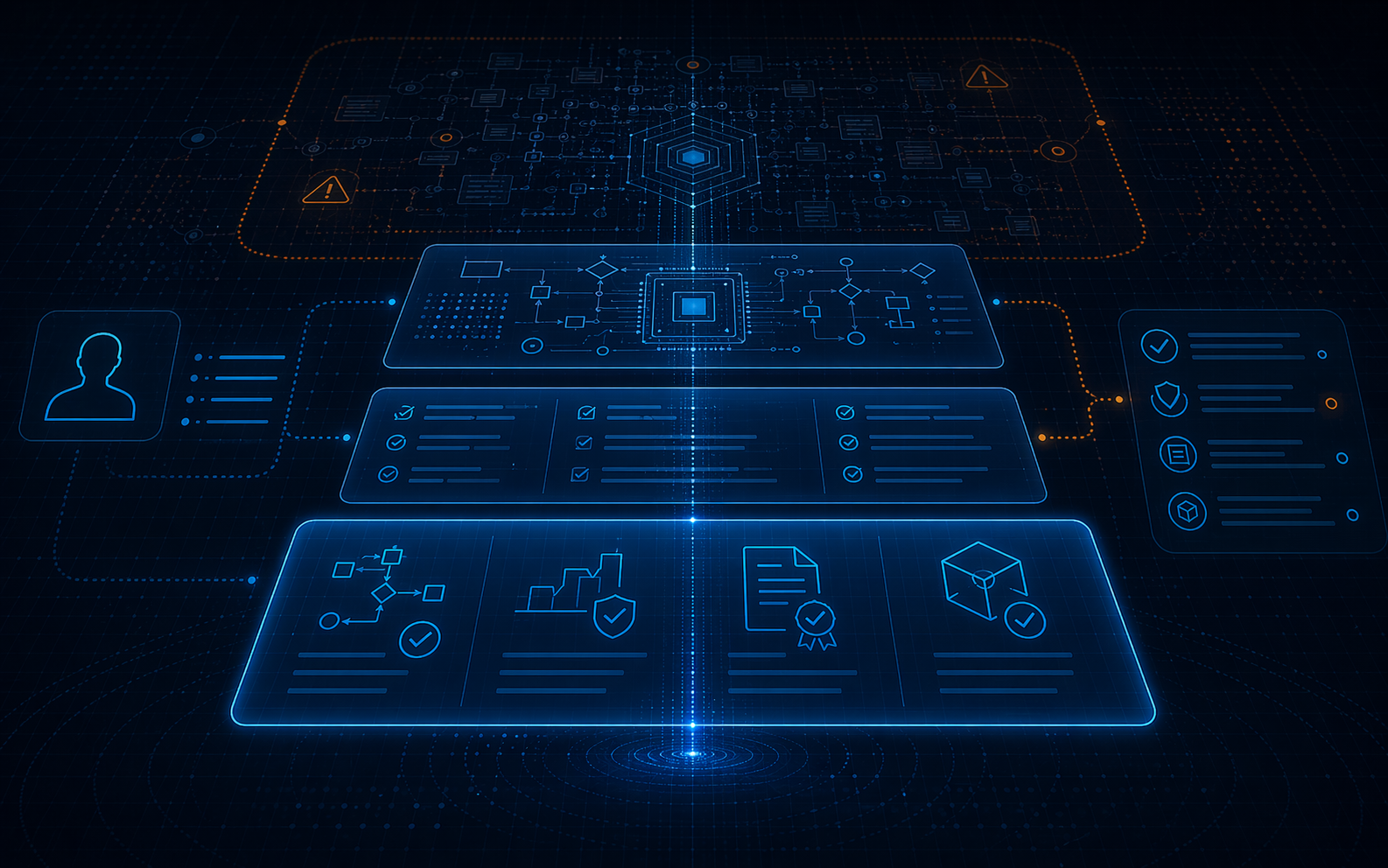
PCD takes a fundamentally different approach. Instead of translating COBOL line by line, it extracts the computational essence — the mathematical logic that the code actually performs — and represents it as a review-scoped circuit. Not a translation. An extraction.
COBOL → BRIK64 CLI lift → PCD Blueprint → BRIK64 CLI build → Rust / JS / Python / Go / C Step 1: LIFT Extract computational logic from COBOL source Step 2: VERIFY Certify the PCD blueprint (closure check passed) Step 3: EMIT Compile to any modern languageStep 1: LIFT — Read the COBOL, Extract the Math The COBOL frontend reads PROCEDURE DIVISION paragraphs, COMPUTE statements, IF/EVALUATE blocks, and PERFORM loops. It does not translate syntax — it identifies the underlying computation. A COMPUTE statement that calculates compound interest becomes a composition of arithmetic monomers. An EVALUATE block that routes transactions becomes a conditional composition. A PERFORM VARYING loop becomes a sequential fold. The logic is preserved. The COBOL syntax is discarded.
Here is the surprising part: COBOL's rigid structure is actually an advantage. Unlike dynamically typed languages where behavior depends on runtime state, COBOL's DATA DIVISION declares every variable, its type, and its size upfront. PROCEDURE DIVISION paragraphs are essentially named functions with explicit inputs and outputs. This maps naturally to PCD's circuit model. COBOL was accidentally designed for this.
Step 2: VERIFY — Prove the Circuit Is Correct
The lifted PCD blueprint is run through the Thermodynamic Coherence Engine. When closure check passed, the circuit is closed — every input produces a deterministic output, every path terminates, every domain constraint is satisfied. This is not a test suite that might miss edge cases. It is a mathematical proof that the extracted logic is internally consistent. 207 proof files back this guarantee.
The verification also establishes behavioral equivalence: the PCD circuit computes the same function as the original COBOL code. If the COBOL computes PRINCIPAL * RATE / 100, the PCD circuit computes the same arithmetic — same operation, review-scoped. Not similar. Identical.
Step 3: EMIT — Compile to Any of 14 Target Languages
Once verified, the PCD blueprint compiles to any of 14 target languages. Rust for performance-critical systems. JavaScript for web interfaces. Python for data pipelines. Go for microservices. C for embedded systems. Swift, TypeScript, C++, PHP, Java, WASM, BIR, or native x86-64. The emitted code includes auto-generated tests that validate behavioral equivalence with the original computation. One blueprint, any destination.
A Real Example — Watch It Work
This is a real COBOL routine — a simplified interest calculation that runs in thousands of banking systems worldwide:
PROCEDURE DIVISION. COMPUTE INTEREST = PRINCIPAL * RATE / 100. IF INTEREST > MAX-INTEREST MOVE MAX-INTEREST TO INTEREST END-IF. COMPUTE TOTAL = PRINCIPAL + INTEREST.
The Lifter reads this and produces a PCD blueprint:
// PCD Blueprint: interest_calc
// Domains: principal [0, 1000000], rate [0, 30], max_interest [0, 100000]
// Computes: interest capped at max, added to principal
// Verified: closure check passed
The PCD circuit does exactly what the COBOL does — but now with explicit domain constraints, mathematical certification, and a liftability score of 0.95+. The TCE certifies closure check passed: the circuit is closed, deterministic, and correct. For the first time, you can see what the COBOL actually computes.
From this single PCD blueprint, you can emit:
BRIK64 CLI build interest_calc.pcd -t rust # High-performance Rust BRIK64 CLI build interest_calc.pcd -t js # Browser / Node.js BRIK64 CLI build interest_calc.pcd -t python # Data pipeline integration BRIK64 CLI build interest_calc.pcd -t go # Microservice deployment BRIK64 CLI build interest_calc.pcd -t c # Embedded / legacy integration
All five outputs are provably equivalent. They compute the same function. The math guarantees it. No other migration tool can make this claim.
Why This Changes Everything
The key insight is that PCD migration is incremental. You do not need a big-bang rewrite. You do not need to shut down the mainframe. You do not need a 100-year project. You lift one COBOL paragraph at a time, verify it, emit it, and deploy it alongside the existing system.
Migration Strategy: Incremental Lift
───────────────────────────────────────── Week 1 Lift INTEREST-CALC paragraph → closure check passed ✓ Week 2 Lift ACCOUNT-BALANCE paragraph → closure check passed ✓ Week 3 Lift TRANSACTION-VALIDATE paragraph → closure check passed ✓ Week 4 Lift FEE-COMPUTATION paragraph → closure check passed ✓ ... Week N All critical paths lifted and verified
───────────────────────────────────────── Original COBOL keeps running throughout. Swap modules when ready. Roll back if needed. The PCD blueprint is the source of truth.Each lifted
function is independently verified. Each can be tested against the original COBOL output. If something goes wrong — and in banking, you plan for things going wrong — the PCD blueprint is the source of truth. Re-emit to a different language. Adjust domain
constraints. Roll back to the COBOL. The blueprint captures the logic permanently. It is your insurance policy.
This eliminates the existential risk that has killed every major COBOL migration attempt. No single cutover date. No "go live" moment where everything might break. A gradual, verified, supported by bounded evidence transition from COBOL to whatever comes next. This is how you migrate 220 billion lines without losing a single transaction.
The Business Case
The COBOL Migration Problem — By the Numbers ───────────────────────────────────────────────── Industry COBOL maintenance spend: $3 billion / year Average migration project duration: 3 – 5 years Migration project failure rate: 60% TSB Bank migration loss (2018): $330 million Commonwealth Bank migration (2012): $750 million over 5 years The PCD Alternative ───────────────────────────────────────────────── Lift-verify-emit cycle per module: Days to weeks Mathematical equivalence proof: Automatic (closure check passed) Rollback capability: Instant (PCD is source of truth) Target language flexibility: Any (Rust, JS, Python, Go, C) New talent pool: Millions of modern developers
The ROI is straightforward. Reduce $3 billion in annual maintenance costs. Access a talent pool of millions of modern developers instead of a shrinking pool of COBOL specialists. Eliminate the 60% failure rate of traditional migration projects. And do it incrementally, without betting the bank — literally — on a single cutover. The math alone justifies the investment.
For a single institution, the calculus is even clearer. A major bank spending $50 million per year on COBOL maintenance can begin lifting critical modules immediately. Each module lifted is a module that can be maintained by any developer who knows Rust, JavaScript, or Python — millions of developers instead of hundreds. The PCD blueprint serves as permanent documentation — something the original COBOL never had.
Getting Started
Then do the next module.
The Stakes Are Real
The COBOL problem is not going away. Every year, more COBOL programmers retire. Every year, the risk increases. Every year, the cost of doing nothing grows. The question is not whether these systems will be migrated — it is whether they will be migrated safely or catastrophically. TSB chose catastrophically. You do not have to.
PCD does not ask you to rewrite 220 billion lines. It asks you to lift them — one function at a time, one circuit at a time, one proof at a time. The computational logic is preserved. The mathematical equivalence is guaranteed. The new code runs in any of 14 languages that the next generation of engineers can actually read, understand, and maintain.
The math does the heavy lifting. You just point it at your code. Start today.